Sensor Polling & Shape
Modern PixArt sensors saturate 1000 Hz USB packets well before your wrist reaches peak flick speed. Here is when 4000 Hz and 8000 Hz polling deliver measurable gains, and how shell geometry affects micro-corrections.
View Polling Curves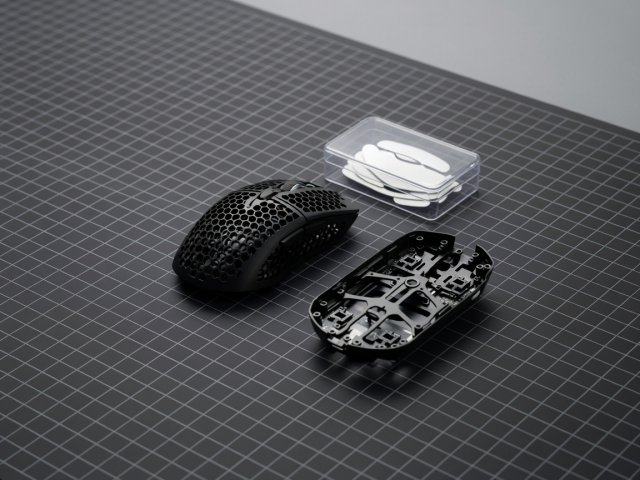
1000 Hz vs 8000 Hz Polling
Raising USB polling from 1000 Hz to 8000 Hz shrinks the worst-case packet wait from 1.000 ms to 0.125 ms. On average, click latency drops by roughly 0.43 ms. On a 60 Hz display that difference vanishes inside a 16.67 ms frame window, yet on 240 Hz and 360 Hz OLED monitors, 4000 Hz polling tightens cursor sample spacing during fast camera pans.
To actually saturate 4000 Hz or 8000 Hz USB reports, set your sensor to at least 1600 CPI. At 400 CPI, slow horizontal tracking does not generate enough optical counts per millisecond to fill every packet, causing intermittent report dips down to 1500 Hz.
Optical vs Mechanical Clicks
Mechanical microswitches like Kailh GM 8.0 and Huano Blue Shell Pink Dot produce crisp tactile feedback, yet oxidation on silver contacts forces mouse firmware to filter chatter for 2 ms to 4 ms. Once contacts pit after 15 million clicks, double-clicking sets in.
Optical switches used in the Logitech G Pro X Superlight 2 and Pulsar X2V2 interrupt an infrared light beam directly. Zero physical contact bounce yields 0.65 ms to 0.90 ms click latency indefinitely. If you prefer mechanical feel without soldering, Endgame Gear OP1 8k exposes main switch PCBs via two bottom screws for rapid swap-outs.
| Mouse Model | Sensor & Max Poll | Click Latency | Weight | Skate Access |
|---|---|---|---|---|
| Endgame Gear OP1 8k | PAW3395 / 8000 Hz Wired | 0.38 ms | 50.5 g | Recessed screw channels |
| Logitech G Pro X Superlight 2 | HERO 2 / 4000 Hz Wireless | 0.82 ms | 60.0 g | Adhesive PTFE under-puck |
| Pulsar X2V2 | PAW3395 / 4000 Hz Wireless | 0.95 ms | 53.0 g | Standard two-piece PTFE |
| Razer Viper V3 Pro | Focus Pro 35K / 8000 Hz | 0.74 ms | 54.0 g | Wide virgin PTFE pads |
Mass, Balance & Skates
Dropping below 58 grams reduces starting inertia during small target adjustments, provided the shell resists sidewall flex. Mice with honeycomb holes cut directly into the palm hump often squeak under claw-grip thumb pressure, whereas solid 0.8 mm ABS shells stay rigid at 50 grams when internal ribbing is well placed.
Center of gravity matters more than a three-gram spec difference. Batteries placed far behind the sensor wheel shift weight toward the wrist, making vertical flicks feel heavier than an identical 55-gram mouse balanced directly over the sensor lens.
Skate & Battery Access
Every internal screw sits beneath the bottom PTFE skates. Heating skates gently for 10 seconds with a hairdryer lifts them without bending the glue backing, or you can replace them with 6 mm virgin PTFE dot skates placed around the perimeter so screws remain accessible without peeling skates again.
Check scroll-wheel encoder sealing as well. Open-frame encoders collect dust fibers within eight months and begin scrolling backward erratically; dust-proof TTC Gold or sealed optical encoders eliminate that failure mode.