Hall-Effect Thumbsticks
Carbon wiper pots remain the single most frequent failure point on first-party console gamepads. We tested Hall-effect and TMR stick modules, wired polling caps, and teardown difficulty.
Check Circularity Data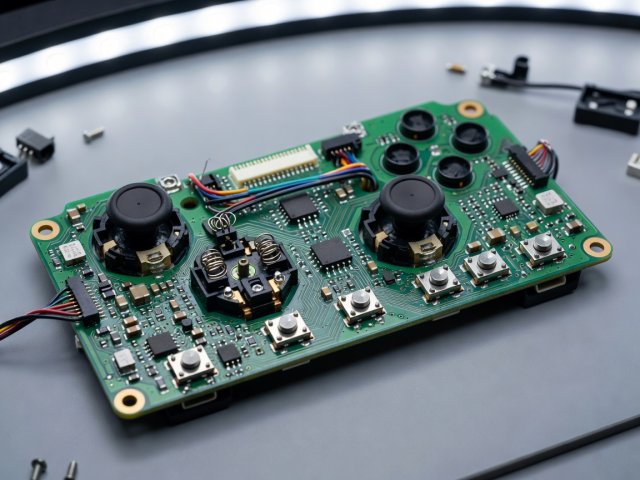
Why Potentiometers Drift
Standard Alps RKJXV thumbsticks sweep two tiny metal wipers across curved carbon-resistive tracks. Every L3 sprint click flexes the housing, carving carbon dust along the center resting point. Once resistance noise exceeds the console's 3% factory deadzone, the reticle creeps permanently upward or left.
Sony's DualSense Edge keeps carbon pots inside snap-out modules held by a latch. While it does not stop wear, swapping a module takes 90 seconds with zero soldering iron required. By contrast, Xbox Elite Series 2 units solder 14 through-hole pins into multi-layer lead-free PCBs that demand a desoldering pump to service.
Hall Effect vs TMR Sensors
Non-contact Hall-effect sticks replace resistive wipers with tiny permanent magnets coupled to solid-state sensors. Because zero parts rub to generate a voltage, electrical wear drops to zero; only mechanical spring centering fatigue remains after thousands of hours.
Newer Tunnel Magnetoresistance (TMR) modules such as Ginfull and K-Silver units draw under a quarter of the current used by traditional Hall chips, preserving battery life on wireless DualSense retrofits while matching potentiometer resistance curves linearly across 4096 steps.
Wired & 2.4 GHz Latency
Microsoft's standard Xbox Wireless protocol caps polling at 125 Hz (8.0 ms interval), whereas third-party PC dongles on the Flydigi Vader 4 Pro and GuliKit KK3 Max sustain 500 Hz to 1000 Hz. Wired USB on DualSense and DualSense Edge runs natively at 1000 Hz (2.9 ms average stick-to-packet delay).
| Gamepad | Wired Poll | Stick Latency | Back Paddles | Stick Tech |
|---|---|---|---|---|
| Sony DualSense Edge | 1000 Hz | 2.9 ms | 2 metal levers | Modular Potentiometer |
| Flydigi Vader 4 Pro | 1000 Hz | 2.6 ms | 4 fixed buttons | Adjustable Hall Effect |
| GuliKit KK3 Max | 1000 Hz | 3.8 ms | 4 removable paddles | 2nd-Gen Hall Effect |
| Xbox Elite Series 2 | 125 Hz | 8.4 ms | 4 magnetic paddles | Soldered Potentiometer |
Microswitch Trigger Stops
Racing titles need progressive 256-step analog Hall triggers, whereas FPS shooters benefit from immediate digital actuation. Controllers such as the Vader 4 Pro physically flip a mechanical cam that locks trigger travel at 0.8 mm directly onto a tactile mouse microswitch, delivering cleaner reset snaps than rubber block stops alone.