Magnetic & Mechanical Switches
Hall-effect keyboards replace metal leaf switches with analog magnetic sensors. We tested actuation floor stability, upstroke reset distance, and stabilizer rattle across 60% and 75% chassis.
Jump to Latency Table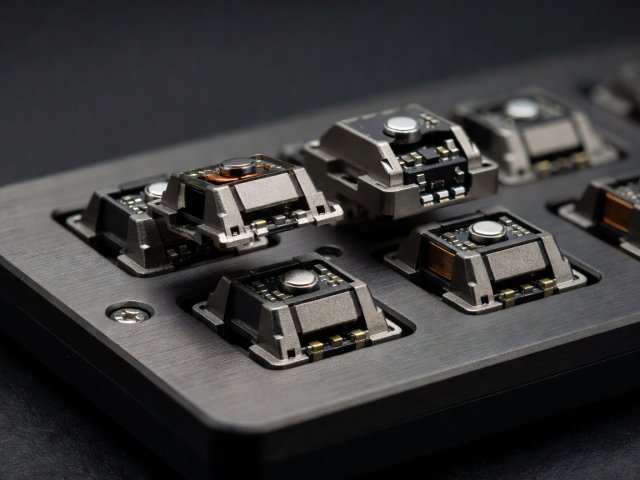
How Hall Flux Sensing Works
In a standard mechanical switch such as the Cherry MX2A Red or Gateron Oil King, pressing the stem pushes two gold-plated copper leaves together at a fixed 2.0 mm mark. Because copper bounces microscopically for 3 to 5 milliseconds on impact, firmware must wait before confirming a key release or subsequent press.
Magnetic keyboards like the Wooting 60HE+ and Keychron Q1 HE house a cylindrical magnet inside the POM stem above a surface-mount Hall sensor on the PCB. As the stem moves through its 4.0 mm stroke, voltage output shifts continuously in proportion to magnetic flux density. Firmware reads that analog curve at 1000 Hz to 8000 Hz and triggers actuation wherever you place the software threshold, down to 0.1 mm.
Rapid Trigger changes the reset logic more than the initial press. Instead of forcing your finger back above a static 1.8 mm boundary, the switch deactivates the instant upward travel exceeds 0.10 mm to 0.15 mm. Counter-strafing in tactical shooters drops 12 ms to 24 ms of physical finger travel per direction change.
Measured Switch Matrix
Every sample was actuated with a linear stepper fixture at 450 mm/s while monitoring USB HID packet arrival and photodiode trigger pulse.
| Switch / Board | Sensing Method | Actuation Floor | Measured Latency | Stem Wobble (X/Y) |
|---|---|---|---|---|
| Gateron Jade / Wooting 60HE+ | Analog Hall Effect | 0.10 mm | 0.92 ms (Tachyon) | 0.18 mm |
| Gateron Nebula / Keychron Q1 HE | Analog Hall Effect | 0.20 mm | 1.65 ms (1000 Hz) | 0.24 mm |
| Cherry MX2A Red (Wired 1K) | Mechanical Crosspoint | 2.00 mm (fixed) | 3.80 ms | 0.31 mm |
| Razer Optical Gen-2 | Infrared Beam Break | 1.50 mm (fixed) | 1.15 ms (8000 Hz) | 0.29 mm |
Gasket Mount & Acoustics
Early Hall-effect keyboards mounted an aluminum plate directly onto tray standoffs, producing uneven hollow resonance around the spacebar and backspace keys. Modern designs add silicone socks around the plate tabs, IXPE switch pads, and closed-bottom magnetic stems such as the Gateron Magnetic Jade.
Closed-bottom housings prevent the magnet from poking through the PCB hole, yielding a cleaner 900 Hz bottom-out tone that drops ambient clack by 4.5 dBA at 50 cm compared to open-bottom Lekker v1 stems. For players who spend six hours a day typing code or documentation alongside matches, mechanical tactile switches still hold a clear ergonomic advantage over linear magnetic springs.
PCB & Stabilizer Service
Hall-effect switches carry zero metal pins, making stem swaps virtually immune to bent-pin PCB damage. Before buying, inspect how the stabilizers attach: PCB-mounted screw-in stabilizers allow clean Krytox 205g0 tuning on wire ends, whereas clipped plate-mounted stabilizers often rattle inside wide spacebars after three months of travel.
Check that firmware configuration runs natively in a Chromium WebHID browser page without background system daemons. Wooting Lekker/Wootility Web and Keychron Launcher store profiles directly on onboard flash memory, leaving zero background CPU polling during matches.